Placer.ai
How CAVA and sweetgreen are Sustaining Growth in Today’s Dining Landscape – Placer.ai Blog
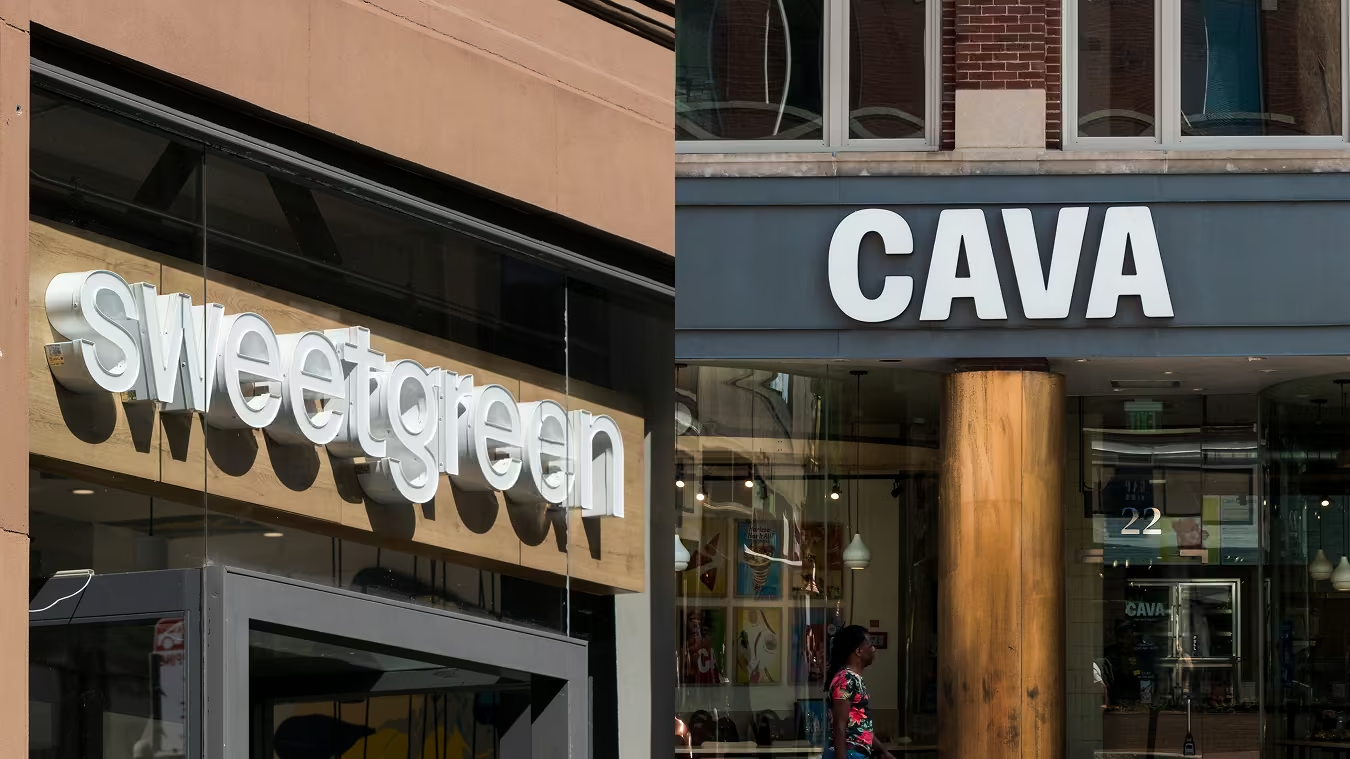
CAVA and Sweetgreen are the subject of a Placer.ai analysis on growth strategies in the current dining environment.
77 stories mentioning Sweetgreen, newest first. Watch to get Sweetgreen news in your daily digest.
CAVA and Sweetgreen are the subject of a Placer.ai analysis on growth strategies in the current dining environment.
Multi-brand menu platform expansion (bowls, wraps, sandwiches) alongside Cracker Barrel's comeback and KFC's three-quarter comp growth show category adaptation and traffic recovery strategies in actio
Seasonal promotional content from brand's own newsroom — no operational insight for multi-location operators.
Routine investor-conference notice with no news content.
C-suite strategic hire at growth-stage fast-casual signals potential M&A readiness or major operational pivot.
Earnings scatter across burger, casual-dining, and fast-casual shows uneven consumer health — loyalty and ops execution now key differentiators.
Quarterly earnings from a major growth-stage fast-casual reveal unit economics, pricing power, and expansion momentum that compete for capital with other concepts.
Sweetgreen is launching wraps as a nationwide menu addition, marking a significant expansion of its core offering.
Earnings show divergent recovery patterns — Chipotle's protein upsells and Starbucks' operational turnaround contrast with Wingstop's struggles, signaling consumer selectivity and pricing power limits
CDO hire at Sweetgreen signals active real-estate/expansion strategy — watch for news on unit growth and site selection discipline.
Consumer-facing farm storytelling campaign — no operator or multi-location business signal.
Earnings announcement placeholder — no substance available to assess relevance.
Post-bankruptcy Red Lobster still struggling and Sysco-Restaurant Depot deal complications highlight M&A execution risk — relevant for operators assessing supply chain stability.
Podcast roundup of live product updates (Pizza Tracker granularity, premium burger margin play, ramen exploration) and promotional tactics across major chains — useful snapshot of what's working this
Sweetgreen's Q4 results are being analyzed alongside other modern fast-casual stocks.
Single-brand menu addition with no strategic or financial signal for multi-location operators.
Sweetgreen is repositioning itself as a lifestyle brand, signaling a shift from pure fast-casual positioning toward broader brand identity and customer engagement.
Sweetgreen has added a macronutrient tracking tool to its platform, signaling a shift toward using customer data to enable personalized ordering experiences.
Sweetgreen divested its restaurant robotics arm to Wonder while expanding its Infinite Kitchen ghost-kitchen format, suggesting the chain is refocusing capital on virtual brands rather than on-site au
Sweetgreen opened a new restaurant in Dallas following its recent initial public offering.
Fast-casual standout entering points-based loyalty signals category-wide shift from simple punch cards to data-driven personalization and retention tools.
Chipotle, Sweetgreen, and other restaurant chains are deploying automation technology, signaling growing industry interest in addressing labor and operational efficiency challenges.
Sweetgreen is expanding its loyalty program to include in-restaurant dining, broadening the reach of its customer rewards beyond its existing channels.
Sweetgreen plans to install its Infinite Kitchen robotic makeline at all new locations, signaling a shift toward automation as the company scales.
Sweetgreen opened its first robotic restaurant, Infinite Kitchen, in Naperville, Illinois, nearly two years after acquiring automated-cooking company Spyce, signaling continued investment in kitchen a
Sweetgreen completed an initial public offering that raised $364 million, marking the fast-casual chain's transition to a publicly traded company.
Sweetgreen is pursuing an IPO with a target valuation up to $2.7 billion despite the chain currently operating at a loss, signaling investor appetite for growth-stage restaurant technology and unit ec